Visit Us
Craft your experience to make the most of your visit.
Rosen House Music Room
Tickets from $55
Music Room
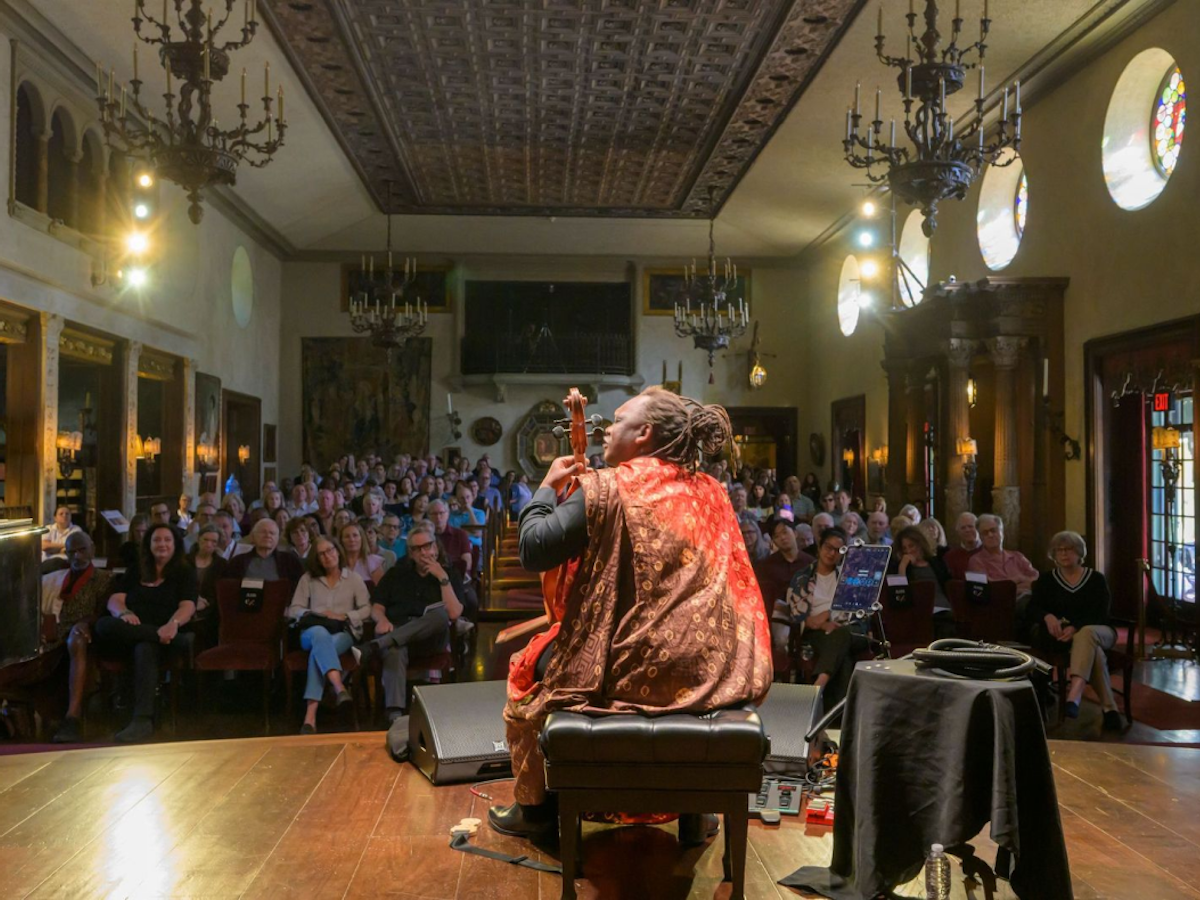
At the heart of the historic Rosen House, the Music Room is a soaring yet intimate space used for chamber music, recitals, American roots music and jazz performances, as well as lectures and Caramoor's popular Afternoon Teas. You’ll find yourself surrounded with Renaissance furniture, stained glass windows and architectural elements the Rosens collected and installed in this unique space. Only covered beverages are permitted inside during performances.
Click to view all upcoming Music Room concerts.
On-Site Dining
The featured vendors at this concert are:
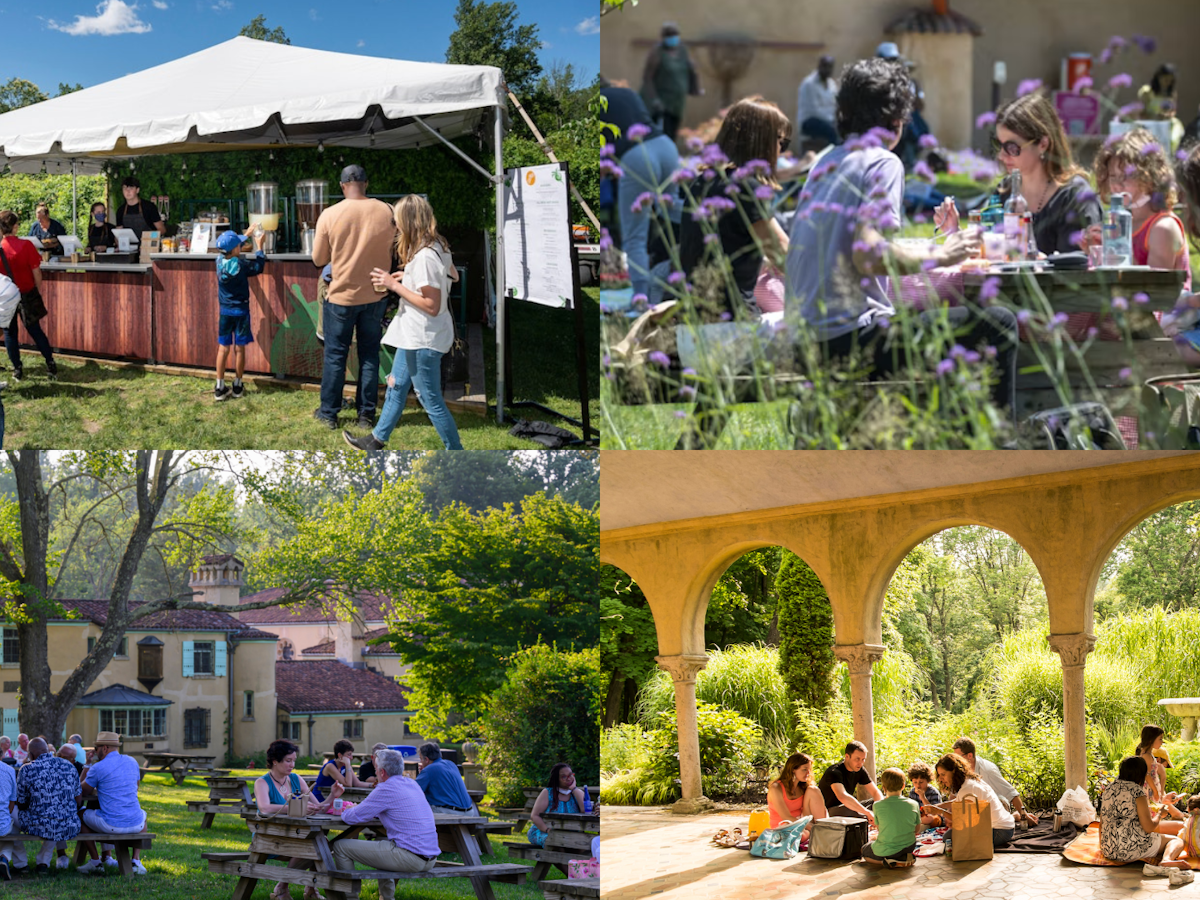
Bravo Bar / Lemonade and iced tea, wine, cocktails and buzz-free beverages will be on ice waiting for you. Pick up curated sweet and savory snacks, and of course ice cream, to help round out your picnic.
Savanna & Steep / A delightful mix of tradition and taste, featuring scones, brownies, macarons and other sweets.
Want to skip the line and dive straight into the music? You can pre-order gourmet sandwich and meal boxes up to 4 days in advance of the concert. Choose your Pre-Order Picnic during the checkout process and your picnic will be waiting for you at the concert! Click here to view the picnic menu.
Bring Your Own / We invite you to spread a blanket out on the lawn, or use our picnic and patio tables to enjoy your own culinary delights..
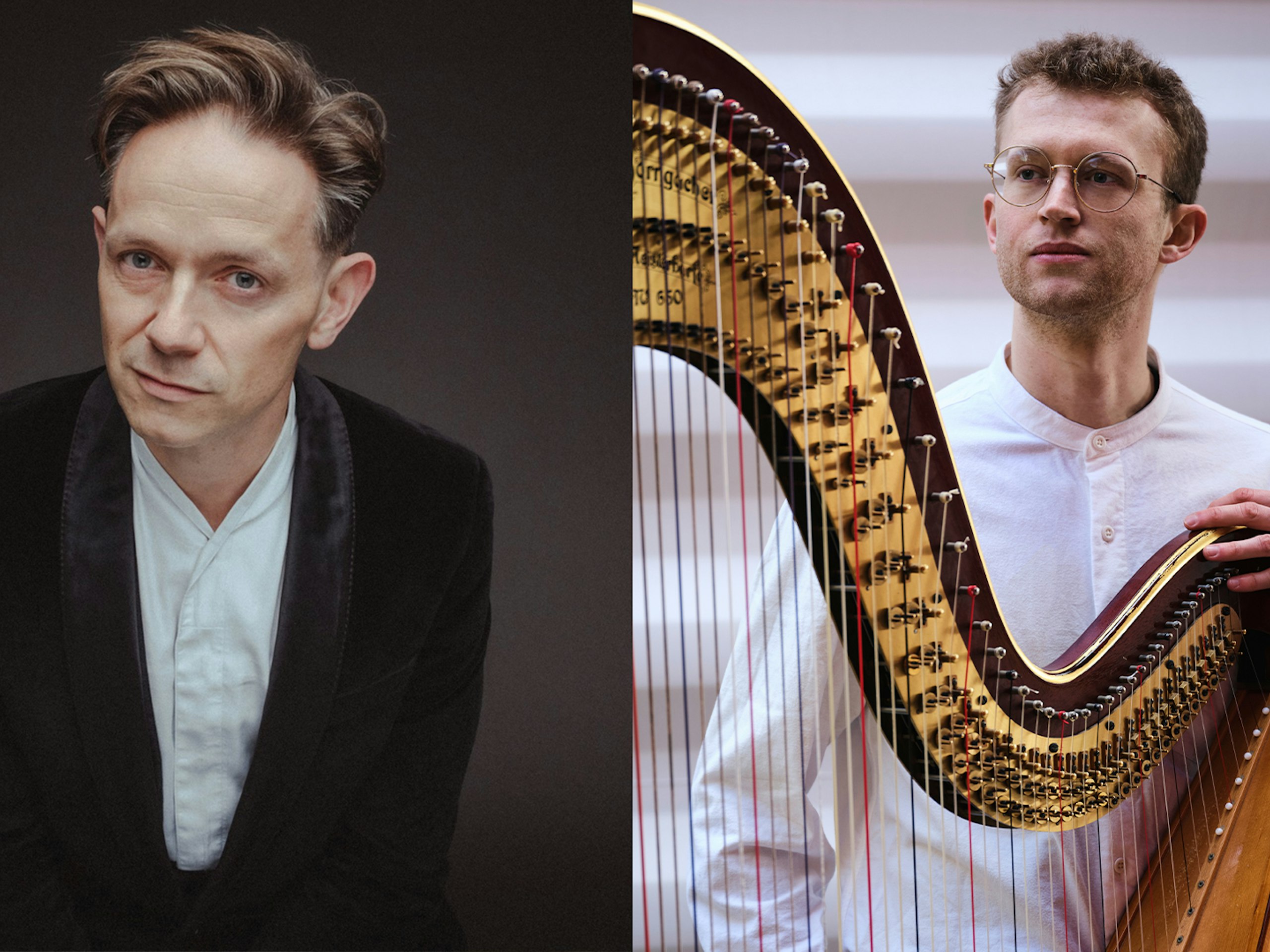
Celebrated British countertenor Iestyn Davies is known or his vocal beauty and technical dexterity. An esteemed Handelian, he is a Grammy winner and recipient of multiple Gramophone awards, with appearances at the Metropolitan Opera, La Scala and Carnegie Hall. He earned an Olivier Award nomination for his performance in the play Farinelli and the King in London and New York. In 2022, Davies appeared with lutenist Thomas Dunford in the Music Room, and now he returns in with Oliver Wass, the first harpist ever to win the prestigious Guildhall Gold Medal, for a recital of works by Dowland, Purcell, Handel, Gluck, Monteverdi and more.
GIOVANNI MARIA TRABACI: Toccata Seconda & Ligature per l'arpa
CLAUDIO MONTEVERDI: Laudate Dominum in sanctis eius SV287
FRANCESCO CAVALLI: Delizie contenti che l'alma beate, from Giasone
HENRY PURCELL: Strike the viol, touch the lute, from Come, ye sons of art, away
J.S. BACH: Allemande from French Suite No.3 BWV 814
JOHN DOWLAND: Say Love if Ever Thou Didst Find; Time Stands Still; Can She Excuse My Wrongs
J.S. BACH: Menuet from French Suite No.3 BWV 814
JOHN DOWLAND: My Thoughts Are Wing'd With Hopes; Flow My Tears
J.S. BACH: Sarabande from French Suite No. 3 BWV 814
JOHN DOWLAND: In Darkness Let Me Dwell; Now, O Now I Needs Must Part
Intermission
CHRISTOPH WILLIBALD GLUCK: Orfeo ed Euridice Cantata (arr. Iestyn Davies)
WOLFGANG AMADEUS MOZART: Rondo Alla Turka (arr. Fazil Say)
GEORGE FRIDERIC HANDEL: Sento Amor, from Partenope
GEORGE FRIDERIC HANDEL: Oh Lord Whose Mercies Numberless, from Saul.
After reading Archaeology and Anthropology at St John’s College, Cambridge, Iestyn Davies studied at the Royal Academy of Music, London.
An esteemed Handelian, he has delighted audiences globally with his vocal agility and supreme musicianship in roles such as Bertarido, Orlando, Rinaldo, Ottone Agrippina and David Saul. Committed also to contemporary music, his intelligent and considered interpretations have led to fruitful collaborations with Thomas Adés, George Benjamin and Nico Muhly.
In the 26/27 season Iestyn will create the role of Jørgen Tesman in the world première of Hedda Gabler by Vasco Mendoça for Dutch National Opera; he will sing Oberon A Midsummer Night’s Dream at the Teatro Maggio Musicale Fiorentino, and Didymus Theodora with the Monteverdi Choir and Christophe Rousset in a tour of South America and Europe. He makes a return to the Barbican Centre to perform works by John Dowland in the ‘theatrical meditation’ An Anatomy of Melancholy with lutenist Monica Pustilnik and will embark on a recital tour of the US with harpist Oliver Wass. Other concerts plans include Bach cantatas with Les Violons du Roy, Handel Messiah with the Philadelphia Orchestra and Orchestra Sinfonica di Milano Giuseppe Verdi, and recitals in Shanghai with guitarist Sergio Bucheli.
An outstanding recitalist, he has performed in Vienna, Tokyo, Paris, and New York in repertoire ranging from Dowland to Clapton. He is a regular favourite at London’s Wigmore Hall and Kings Place where he has curated residencies, most recently a weekend at Wigmore Hall celebrating John Dowland’s 400th anniversary. His recital discs have won three Gramophone Awards, and he performed on the Grammy-winning recording of Thomas Adès’s The Tempest. In 2017 he was awarded an MBE by Queen Elizabeth II for his services to music.
Oliver Wass is an award-winning soloist and chamber musician, and is Professor of Harp at the Royal College of Music in London.
He has won the Suoni d’Arpa International Competition in Italy, the International Harp Competition of Slovenia, and the Jury Prize at the International Harp Competition in Szeged, Hungary. In May 2016 he became the first harpist ever to win the Guildhall Gold Medal — the Guildhall’s most prestigious prize.
He has performed every major harp concerto, including Lyra Angelica with the Philharmonia Orchestra, the Mozart Flute and Harp Concerto with The Mozartists at Wigmore Hall, and the Debussy Danses with 12 Ensemble at Wigmore Hall. He has also directed the Handel Harp Concerto in the Barbican Hall.
He plays both modern and early harps, and has performed the Handel Harp Concerto with the English Concert at Wigmore Hall on the triple harp, as well as touring to Carnegie Hall, the Berlin Philharmonie, and the Salzberg Mozarteum.
Playing with “verve and polish” (The Times), his flute-viola-harp trio The Pelléas Ensemble won the Royal Philarmonic Society Henderson Award and the Elias Fawcett Award for Outstanding Chamber Ensemble at the Royal Overseas League competition. They have also won both the Grand Prize and the Audience Prize in the St Martin-in-the-Fields Chamber Music Competition.
Oliver holds a First Class Master’s Degree from the Guildhall School of Music & Drama, where he studied with Imogen Barford. He graduated from the University of York with a First Class Honours degree in Chemistry.
He spent his teenage years making fireworks in his parents’ basement. Remarkably, he still has all his fingers.
Born in Cremona, Claudio Monteverdi was the premier musical genius of the first half of 17th-century Italy. Over the course of his long career, he created the first opera in the standard repertoire, L’Orfeo, in 1607, as well as masterpieces of sacred music for voices and instruments for San Marco that made that filled the Venetian basilica with sounds as dazzling as its interior. Monteverdi’s Laudate Dominum is a setting of Psalm 150, whose praise of God is enhanced by its textual imagery of musical instruments proclaiming His power. Here Monteverdi created brilliantly virtuosic writing for his singer, set in a high range and filled with shimmering melismas.
Joining the choir of Venice’s San Marco in 1616 and tutored by Monteverdi, Francesco Cavalli became his successor in translating opera from a courtly pastime to a public entertainment. Probably the most popular opera of Cavalli’s day, Giasone (1649) is a convoluted retelling of the myth of Jason and his quest for the Golden Fleece, focusing on Giasone’s promiscuous love life with the sorceress Medea and Queen Isifile of Lemnos. In Act I, Giasone is late to join the Argonauts on his mission because he has spent the night with Medea. When he finally appears, he sings “Delizie, contenti” as he remembers those sexual delights rather than the perilous mission ahead of him.
One England’s greatest composers, Henry Purcell excelled in vocal music, creating a new standard for setting the English language with clarity and sonic beauty. He was a master of “word illustration,” the art of conveying both the meaning of words and their emotional connotations through the imaginative use of melodic shapes, harmonic colors, and rhythm. When William of Orange and his wife Mary jointly assumed the English throne, Purcell was commissioned to write a number of odes to celebrate Mary’s birthdays. The last of these, Come Ye Sons of Art, contains the lovely aria for countertenor “Strike the Viol,” its charming music closely matched to Nahum Tate’s music-inspired verse.
At the turn of the 16th century into the 17th, English music achieved a moment of great florescence with the intimate genre of the lute song, whose finest exponent was John Dowland. Melancholy songs about love lost or rejected were the fashion of the day, but Dowland clearly knew well the black world of depression. “Semper Dowland, semper dolens” (“Always Dowland, always doleful”) was the motto he took for himself.
The first four songs on the program, however, are lighter, describing the games played between an eager man and reluctant woman in courtly romance, especially “Can She Excuse My Wrongs,” one of Dowland’s most popular songs. Here, the singer is actually blaming the faults of his unkind lady, rather than his own.
With “Flow, My Tears” and “In Darkness Let Me Dwell” we experience Dowland’s genius at its most potent. These are songs in which he explores the darkest human emotions with unflinching force, far beyond Elizabethan conventions. “In Darkness” is not only Dowland’s finest, it is one of the greatest songs written in the English language. Composed around 1610, it looks far ahead of its time in its daring use of harmony, dissonance, and rhythmic freedom to express its words of utter desolation.
With his Orfeo ed Euridice Cantata, Iestyn Davies has arranged the most significant music sung in Austrian composer Christoph Willibald von Gluck’s 1762 opera by the title character, Orfeo. It sets the familiar story from Greek mythology of Orpheus, greatest of all musicians, who seeks to win back his recently deceased young wife, Euridice, from the underworld. So compellingly beautiful is his singing that the spirits of the underworld agree to let him take her back to the world of the living, with the condition that, until he has crossed the River Styx, he must never look back at her.
With this eloquent opera, Gluck was endeavoring to reform the old Baroque opera seria style in which singers vied with each other to create impossibly virtuosic embellishments for their da capo arias. Instead, he believed music should serve, not obscure, the words and that drama and music should coexist in classical balance. As he wrote: “I believed that my greatest labor should be devoted to seeking a beautiful simplicity.” That beautiful simplicity is embodied in Orfeo’s first aria, “Chiamo il mio ben cosi.” Calling in vain for Euridice to respond, it is in rondo form framed by a flowing refrain enclosing contrasting, recitative-like episodes. It closes with a frantic cry to the gods (“Numi! barbari”), which summons Amor to appear with a plan to rescue Euridice from Hades. After Amor instructs him to not look at Euridice on their way back to the world, Orfeo, in the dramatic recitative “Che disse! Che ascolta!,” accurately predicts how difficult this task will be.
Armed only with his lyre and his voice, Orfeo arrives at the gates of the underworld and sings the lyrical aria “Deh! Placatevi con me,” which melts the hearts of the infernal guards, who allow him to pass. Next he enters the Elysian Fields, home to the heroes and heroines of the ancient world and his Euridice. To describe this idyllic realm full of air and light, Gluck creates the ravishing aria “Che puro ciel,” filled with imitations of birdsong.
Despite his valiant efforts, Orfeo is unable to endure Euridice’s pleas that he look at her, and when at last he does (“Vieni, segui”), she immediately expires. Her second death leads seamlessly into the opera’s most famous aria, “Che faro senza Euridice,” another rondo-form aria so heartbreakingly beautiful that it seems to demand the happy ending that Amore, promptly delivers.
Born in Germany but making his career in England, George Frideric Handel dominated two major Baroque vocal categories over his illustrious career: Italian opera and English-language oratorio. Davies has chosen an aria from each genre. Premiered at the King’s Theatre in London in 1730, Partenope was, unusually, not a traditional Baroque opera seria, but an appetizing mixture of comedy with hints of tragedy. The title character, the queen of Naples, is besieged by multiple suitors for her hand. Her favorite, Prince Arsace of Corinth, is trailed by his girlfriend Rosmira, who has disguised herself as a man to win him back. Arsace’s opening aria, “Sento Amor,” is a proud, almost arrogant aria in a martial style; its lavishly ornamented lines are exactly what Gluck was trying to purge from his music.
Set to a libretto by Charles Jennens (later author of Messiah’s text), Saul was Handel’s first great success in the oratorio genre. It tells the Old Testament story of King Saul’s downfall, when his jealousy of David’s triumph over Goliath and popularity with the Israelite people drives him to murderous insanity. One of the finest — and also quietest — moments in the score is “O Lord, whose mercies numberless,” David’s gentle song attempting to calm the king after his first violent outbreak. Not an elaborate da capo aria but a simpler strophic air, it is made unforgettable by the poignant melismas that cap each stanza.
INSTRUMENTAL SELECTIONS
Making an ideal curtain raiser for this concert is the Toccata Seconda & Ligature for Harp, published in 1603 by Giovanni Maria Trabaci, a contemporary of Monteverdi and a composer and organist at the court of Naples. A toccata or “touch piece” is a prelude-like work that the player usually performs before a longer piece; it involves a testing-out of the instrument throughout its range.
The remaining instrumental pieces were originally composed for keyboard. Johann Sebastian Bach was a supreme teacher as well as composer. His numerous children were among his most gifted pupils; another family pupil was his second wife, Anna Magdalena Bach, for whom he created two compilations of instructional pieces known as the Clavier-Büchlein. In the second, given to her in 1725, can be found five of the six French Suites for keyboard. Bach transformed a pedagogical purpose into high art in these effervescent examples of the Baroque dance-suite form, drawn from the standard international dances used by Baroque composers. From the French Suite No. 3 in B minor, we will hear the elegant Allemande in four beats, then a livelier three-beat pair of Menuets flowing continuously in eighth notes, and finally the beautiful, melancholy Sarabande in a slower three beats.
The irresistible Ronda alla Turca is surely Wolfgang Amadeus Mozart’s most beloved piano work. Written in 1784 as the finale for his Piano Sonata No. 11 in A Major, it has taken on a life of its own as a popular encore piece. Austrians in the late 18th century were fascinated by the exotic style of the Turkish Janissary bands, which they considered barbaric and comical. With its pounding rhythms and lurches between major and minor, this little piece never ceases to delight.
— Janet E. Bedell
Craft your experience to make the most of your visit.
Your support brings performances to life, preserves Caramoor’s historic legacy, and nurtures the artists of tomorrow. Every gift matters—and makes you part of the Caramoor family.